Schism
The Hellbound HeartThe Schism is the dividing boundary between the ordinary world and the Cenobite realm, but it is not an absolute wall: the Configuration can open a passage, prisoners can see places they once knew, and crossing depends on invitation and opportunity. Its rules shape both Frank Cotton’s confinement and Kirsty’s encounter with the Cenobites, making the boundary a source of access as well as separation.
Definition and Opening
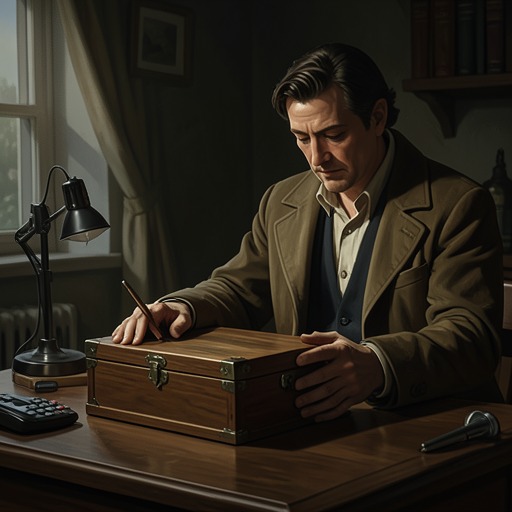
The Schism first becomes perceptible to Frank when he nearly finishes solving Lemarchand’s Configuration. A solemn bell sounds from beyond the door the box was made to open. Kircher had promised that the puzzle would reach another world, and Frank recognizes the sound as evidence that the promise is true: the distant realm is suddenly near, and the Cenobites have been summoned across the divide.
The passage is not presented as an ordinary doorway. The bell announces a change in access before the door itself is visible, and the room becomes a threshold between Frank’s familiar surroundings and a realm governed by the Cenobites. The Schism therefore names not simply distance between two places, but a boundary whose opening has consequences and whose passage is controlled.
Rules of Passage
The Schism’s rules are clearest in Frank’s understanding of possible escape. The Cenobites can be summoned across it, but cannot enter the ordinary world without an invitation; without one, they remain outside. A prisoner who found a way back, Frank believes, could therefore escape without the Cenobites following. The possibility is uncertain, described as a loophole rather than a reliable route, but it gives escape a specific logic: crossing back would sever the access that brought the prisoner into their power.
The boundary also allows sight without freedom. During his captivity, Frank can look out from his resting place into the upper room of 55 Lodovico Street, the very location where he had worked the Configuration. For almost a year the view offers no change. When Rory and Julia arrive at the house, however, the familiar room gives Frank new hope. The Schism keeps him imprisoned while preserving his awareness of the world he left, turning a view into both a reminder of separation and the condition that makes escape seem possible.
Frank’s Confinement and Limited Contact
Frank’s confinement shows that separation does not prevent every form of contact. In the Damp room, Julia finds that the boards where Rory’s blood had fallen have been cleaned. In the darkness, she sees a damaged human figure within the wall. The being is too weak to explain what has happened, but it reaches her enough to identify himself as Frank and ask for blood. Julia later understands that he has been in the house all along, shut away from the world she inhabits but close enough to make a frail connection.
This encounter does not establish that the wall is itself the Schism or explain exactly how Frank reaches Julia. It does show the novel’s recurring distinction between full passage and partial contact: Frank remains trapped, yet a trace of him becomes perceptible across the barrier of the wall. His potential escape also depends on such a trace. He believes that a remnant of himself remained in the room and that Rory’s accidental chisel slip gave him an opening to gain a hold in the world again. The Schism’s boundary is thus difficult to cross, but not necessarily sealed against every fragment or consequence.
Kirsty and the Unintended Opening
Kirsty encounters the Schism in the hospital while working through the Configuration. As she reaches into its mechanisms, the bell rings; the hospital walls seem subtly out of true, and she realizes that the sound is coming from behind her rather than outside. The bedside light goes out, and a Cenobite appears. The episode makes clear that the Schism can be reopened through the box even when the person handling it does not understand what she has done.
The Cenobite tells Kirsty that this has happened before and that the Schism cannot be sealed until the Cenobites reclaim what belongs to them. Kirsty is told to accompany the visitor, then offered a way to avoid punishment: she must deliver Frank alive and make him acknowledge who he is. The bargain ties the boundary’s closure to a specific recovery, rather than to Kirsty’s ability to reverse the opening herself.
Narrative Significance
Across Frank’s summoning, his imprisonment, and Kirsty’s hospital encounter, the Schism operates through unequal forms of access. The Configuration can summon the Cenobites, but they cannot simply cross at will; Frank can observe his former room, but observation does not free him; and Kirsty opens the passage accidentally, then learns that its closure is bound to the Cenobites’ claim. The boundary turns knowledge and proximity into stakes: seeing the other side may sustain hope or announce danger, while crossing requires a summons, a loophole, or a bargain. Its repeated appearance also unsettles ordinary spaces—the house and the hospital—by making them vulnerable to a realm they cannot ordinarily contain.